Introduction
Markets can move in your favor one minute and reverse the next. Every trader—whether dealing in stocks, forex, or cryptocurrency—has felt that painful moment when profits vanish because a trade wasn’t protected. This is exactly where trailing stop loss becomes a powerful tool.
A trailing stop loss is one of the smartest risk-management strategies traders use to protect gains while allowing profits to grow. Instead of locking a fixed exit point, this dynamic stop moves along with the price when the market moves in your favor.
For beginners, the concept may sound technical. But in reality, it’s quite simple and incredibly useful. When used correctly, it can automate discipline, remove emotional decision-making, and protect capital—something even professional traders rely on daily.
In this guide, we’ll explore how the strategy works, why it’s widely used across financial markets, and how you can apply it effectively in real trading situations.
What Is Trailing Stop Loss
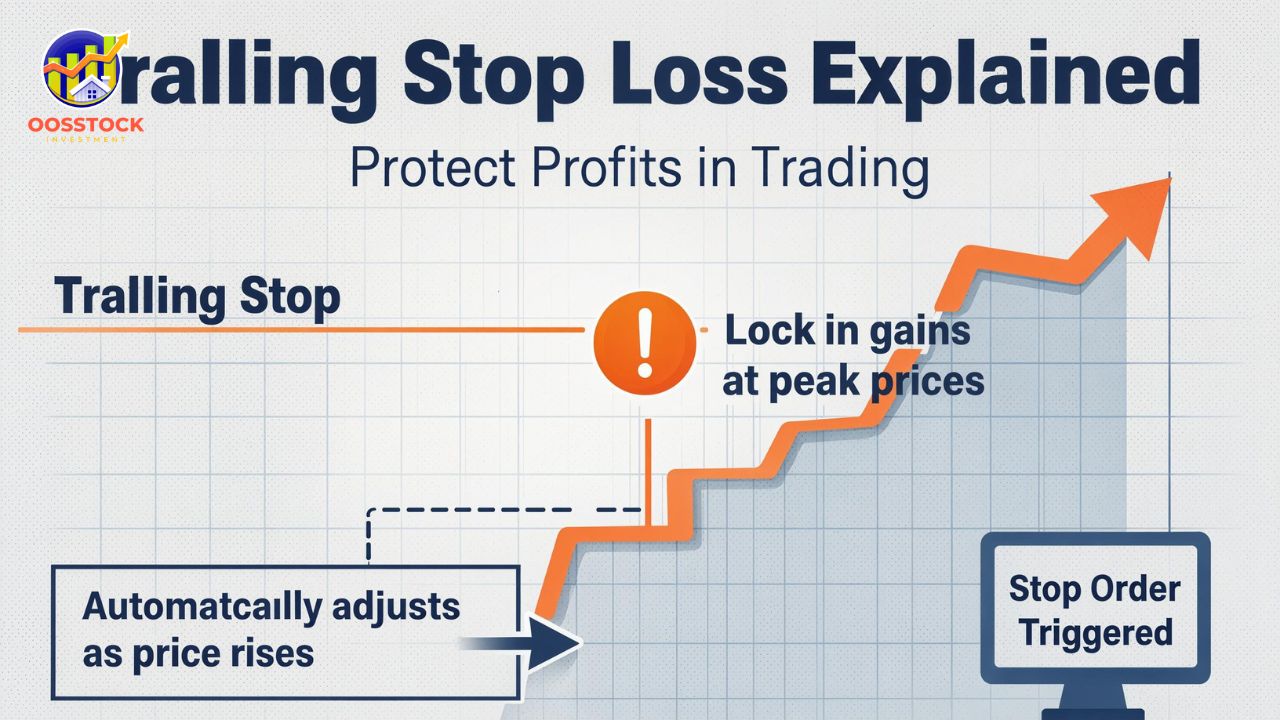
A trailing stop loss is a type of stop order that automatically adjusts as the price of an asset moves in a favorable direction. Instead of staying fixed, the stop level “trails” the price by a set amount or percentage.
For example:
| Trade Scenario | Entry Price | Trailing Distance | Stop Level |
|---|---|---|---|
| Buy Stock | $100 | $10 | $90 |
| Price Rises | $120 | $10 | $110 |
| Price Falls | $110 | $10 | Sell triggered |
In simple terms:
- The stop moves up when price rises
- The stop does not move down if price falls
This protects profits while keeping the trade open during strong trends.
Key Characteristics
A trailing stop loss has three important features:
- Dynamic stop level
- Automated protection
- Trend-following capability
These characteristics make it extremely popular among both manual traders and algorithmic trading systems.
How Trailing Stop Loss Works
Understanding how the mechanism works can dramatically improve trading decisions.
The Core Principle
When you place a trailing stop loss, you define a distance from the market price. That distance can be:
- Fixed amount (e.g., $2)
- Percentage (e.g., 5%)
- Volatility based (ATR)
As the price moves up, the stop follows.
However, if the price reverses by the defined amount, the trade closes automatically.
Step-by-Step Example
Imagine you buy a stock at $50.
- You set trailing stop distance = $5
- Price rises to $60
- Stop automatically adjusts to $55
- Price falls to $55
- Trade closes with profit
Without this strategy, the trader might hold the position too long and lose gains.
Trailing Stop vs Traditional Stop Loss
| Feature | Stop Loss | Trailing Stop Loss |
|---|---|---|
| Movement | Fixed | Dynamic |
| Profit Protection | Limited | Strong |
| Automation | Basic | Advanced |
| Trend Following | No | Yes |
This flexibility explains why experienced traders prefer trailing stops.
Why Traders Use Trailing Stop Loss
The financial markets are unpredictable. Even the best analysis cannot guarantee future price movements.
That’s why risk management tools like trailing stop orders are essential.
1. Protect Profits Automatically
The most obvious benefit is profit protection.
Instead of manually adjusting stops every time the market moves, the system automatically locks in gains.
2. Remove Emotional Trading
Human emotions often sabotage trading decisions.
Common mistakes include:
- Holding losing trades too long
- Closing winning trades too early
- Panic selling during volatility
A trailing stop loss enforces discipline by following predefined rules.
3. Capture Large Trends
Some of the biggest trading profits come from long trends.
Examples include:
- Tesla stock rally
- Bitcoin bull markets
- Forex trend cycles
Trailing stops allow traders to ride trends while maintaining protection.
Types of Trailing Stop Loss Strategies
Different trading styles require different approaches.
Fixed Amount Trailing Stop
This is the simplest method.
Example:
- Stock price = $100
- Trailing stop = $5
Stop adjusts every time the price increases by $5.
Best for:
- Beginner traders
- Low volatility assets
Percentage Trailing Stop
Instead of a fixed amount, the stop is based on a percentage.
Example:
- Entry price = $100
- Trailing stop = 5%
- Stop = $95
If the price rises to $120, the stop moves to $114.
Best for:
- Long-term investing
- Swing trading
Volatility-Based Trailing Stop
Advanced traders often use the Average True Range (ATR) indicator.
This adjusts stops based on market volatility.
Benefits include:
- Adapting to market conditions
- Reducing false stop triggers
- Allowing natural price fluctuations
How to Set the Right Trailing Stop Loss
Setting the stop too tight or too wide can ruin a strategy.
Factors to Consider
Market Volatility
Highly volatile markets require wider trailing distances.
Examples:
| Market | Volatility | Suggested Stop |
|---|---|---|
| Forex | Medium | 2-3% |
| Stocks | Medium | 5-10% |
| Crypto | High | 10-20% |
Trading Style
Different traders use different stop strategies.
| Trader Type | Stop Strategy |
|---|---|
| Day Trader | Tight stops |
| Swing Trader | Medium stops |
| Long-Term Investor | Wide stops |
Support and Resistance
Smart traders place stops near key technical levels such as:
- Trendlines
- Moving averages
- Previous lows
This prevents premature trade exits.
Trailing Stop Loss in Different Markets
This technique is widely used across financial markets.
Stock Market
Investors use it to protect profits during long bull runs.
Example:
Apple stock increased over 1,000% between 2010 and 2020.
A trailing stop could have captured much of this move.
Cryptocurrency Trading
Crypto markets are extremely volatile.
Using trailing stops helps traders protect profits during rapid price swings.
Many exchanges like:
- Binance
- Kraken
- Bybit
offer automated trailing orders.
Forex Market
Forex traders use trailing stops to capture large currency trends.
Because forex trades often run for days or weeks, dynamic stop orders become extremely useful.
Advantages of Trailing Stop Loss
There are several reasons traders prefer this strategy.
Automated Risk Management
Once set, the system manages the trade automatically.
Locks in Profits
Even if the market reverses suddenly, gains remain protected.
Reduces Stress
Traders don’t need to constantly monitor charts.
Improves Trading Discipline
Rules replace emotional decisions.
Limitations and Risks
While powerful, trailing stops are not perfect.
Market Noise
Short-term volatility can trigger the stop prematurely.
Poor Distance Settings
Setting the stop too tight may close profitable trades early.
Platform Limitations
Some trading platforms execute trailing stops locally rather than server-side.
This can create risk if the system disconnects.
Real-Life Trading Examples
Let’s examine a real scenario.
Bitcoin Bull Run Example
Bitcoin rose from $10,000 to $60,000 during the 2020-2021 rally.
Imagine a trader used a trailing stop loss of 15%.
| Price | Stop Level |
|---|---|
| $10,000 | $8,500 |
| $30,000 | $25,500 |
| $60,000 | $51,000 |
When the market reversed, the trade would close around $51,000—locking massive profits.
Without trailing stops, many traders lost gains during the crash.
Personal Background of the Strategy in Trading Evolution
The concept of trailing stops didn’t appear overnight.
It evolved alongside the growth of modern financial markets and electronic trading.
Early Trading Era
Before digital platforms, traders placed manual stop orders through brokers. Adjusting stops required constant monitoring and phone calls to trading desks.
Because of this inconvenience, many traders simply avoided adjusting stops—leading to large losses during market reversals.
Rise of Algorithmic Trading
In the late 1990s and early 2000s, electronic trading platforms introduced automated order types.
These included:
- Limit orders
- Stop loss orders
- Trailing stop systems
Professional hedge funds and institutional traders quickly adopted them.
Today, algorithmic trading systems often rely on trailing stops as part of sophisticated risk management frameworks.
Financial Impact and Trading Success
Many successful traders attribute part of their success to disciplined risk control.
Some famous trading principles include:
- “Cut losses quickly.”
- “Let profits run.”
Trailing stops perfectly implement this philosophy.
While it’s impossible to estimate a specific “net worth” associated with the strategy, traders who consistently apply risk-management techniques often outperform those who rely purely on predictions.
In reality, the difference between profitable and unprofitable traders often lies not in forecasting ability—but in how they manage risk.
FAQ
What is trailing stop loss in simple terms
A trailing stop loss is a dynamic stop order that moves with the market price when it moves in your favor, helping protect profits automatically.
How does trailing stop loss differ from stop loss
A traditional stop loss remains fixed, while a trailing stop moves upward as the asset price increases.
Is trailing stop loss good for beginners
Yes. It helps beginners avoid emotional trading and protect profits automatically.
What is the best trailing stop percentage
Many traders use:
- 5% for stocks
- 10–15% for crypto
- 2–3% for forex
However, the ideal percentage depends on volatility.
Can trailing stop loss guarantee profit
No trading strategy guarantees profit. However, it significantly improves risk management.
Do all brokers offer trailing stop orders
Most modern brokers and exchanges support trailing stops, but features vary between platforms.
Should long-term investors use trailing stop loss
Yes, especially during strong bull markets, because it allows investors to ride trends while protecting gains.
Does trailing stop loss work in crypto
Yes. Many crypto exchanges provide automated trailing stop functionality.
Conclusion
Successful trading is not just about predicting where prices will go—it’s about protecting capital when things go wrong. That’s why tools like the trailing stop loss are considered essential by professional traders.
By allowing profits to grow while automatically protecting against reversals, this strategy provides a balanced approach to risk and reward. Whether trading stocks, forex, or cryptocurrency, using trailing stops can dramatically improve discipline and long-term performance.
The key is learning how to set the right distance, understanding market volatility, and integrating it into a broader trading strategy. With patience and practice, it becomes one of the most powerful tools in a trader’s risk-management arsenal.